

Investors Underground – The Momentum Playbook
$19.99
REGULAR PRICE -$ 497 .
WE OFFER – $ 19.99 .
About Course :-
Learn the exact momentum trading setups active traders use to trade daily volatility — with real examples, not just theory.
Most trading courses teach you indicators. The Momentum Playbook teaches you decisions — how to read a chart in real time, recognize a setup as it forms, and know exactly when to get in, when to get out, and when to stay away.
This is a step-by-step momentum trading course built for traders who want less theory and more execution.
What You’ll Master
- Pattern Identification — Learn to recognize the highest-probability momentum patterns before they play out
- Catalysts & Context — Understand what actually moves stocks (news, float, volume, sector strength) and how to trade around it
- Entry Triggers — Precise, rules-based entries so you’re not guessing when to pull the trigger
- Exit Triggers — Know your exit before you’re in the trade — a core habit of successful momentum traders
- Risk Management — Position sizing and stop-loss frameworks to protect your account
- Position Management — How to scale in, scale out, and manage a trade while it’s live
- Risks & Pitfalls — The common mistakes that blow up momentum trading accounts, and how to avoid them
What You Get :-
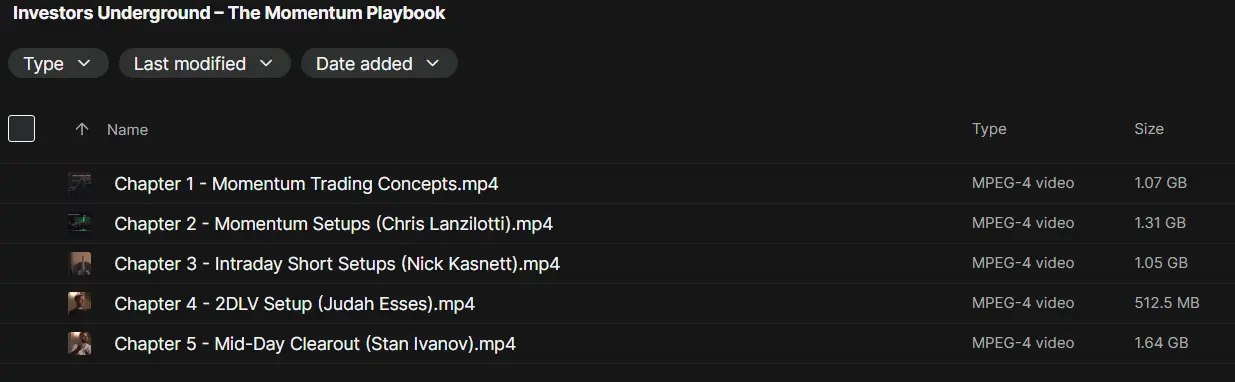
| Content Name | File Size |
|---|---|
| Chapter 1 – Momentum Trading Concepts | 1.07 GB |
| Chapter 2 – Momentum Setups (Chris Lanziotti) | 1.31 GB |
| Chapter 3 – Intraday Short Setups (Nick Kasnett) | 1.05 GB |
| Chapter 4 – 2DLV Setup (Judah Esses) | 512.5 MB |
| Chapter 5 – Mid-Day Clearout (Stan Ivanov) | 1.64 GB |
Who This Is For
Whether you’re a beginner trader trying to understand day trading strategies for the first time, or an intermediate trader looking to sharpen your momentum trading setups, this course breaks each concept down with real, annotated trade examples so you can apply it immediately.
FAQ :-
1. What is momentum trading and how does it work?
Momentum trading is a strategy where traders buy or sell stocks based on the strength of their recent price movement, aiming to profit from continued volatility in the short term. Traders look for stocks with a clear catalyst — like news, earnings, or unusual volume — that’s driving strong directional movement, then enter and exit using specific technical triggers rather than holding long-term.
2. Is momentum trading good for beginners?
Momentum trading can work for beginners, but it requires a solid grasp of risk management, pattern recognition, and disciplined entry/exit rules before trading with real capital. The Momentum Playbook is built to take traders from foundational concepts to real, rules-based execution using annotated examples, so beginners aren’t left guessing.
3. What are the best momentum trading setups for day trading?
The most reliable momentum setups combine a strong catalyst (news, volume, or sector strength) with a recognizable chart pattern and a clear entry trigger. Common examples include breakout setups, pullback entries, and reversal patterns — all of which are covered step-by-step in this course with real trade examples.
4. How much money do I need to start momentum trading?
There’s no fixed minimum, but position sizing should always be based on your account size and risk tolerance — not the price of the stock. This course covers position and risk management frameworks so traders can size trades appropriately at any account level, including strategies suited to smaller accounts.
5. What’s the difference between momentum trading and swing trading?
Momentum trading typically involves shorter holding periods (minutes to a few days) and focuses on capturing a stock’s strongest directional move, while swing trading holds positions for several days to weeks to capture broader price swings. Momentum trading generally requires faster decision-making and tighter risk controls, both of which are core focuses of this course.
View More Courses – Click Here
You must be logged in to post a review.
Related products
-
Sale!
 Forex & Currency Trading
Pivot Boss Bootcamp Strategies
Original price was: $297.00.$12.50Current price is: $12.50. Add to cart -

-
-


Reviews
There are no reviews yet.