
I Tried Learning AI Video Creation Without Filming or Editing — Here’s What Actually Works (2026 Guide)
Discription :-
A few months ago, a friend of mine wanted to start a YouTube channel. She had good ideas, a clear niche, and the drive to be consistent. What she didn’t have was a camera, editing skills, or the confidence to talk on screen. Within two weeks, she’d given up.
Download Now – Click Here
That’s not a rare story. It’s probably the single biggest reason most people never post their first video — not lack of ideas, but the sheer friction of filming and editing. So when I started digging into AI-based content creation, specifically Lambros Lazopoulos’s AI Content Creation & Viral Video Masterclass 2026, I wanted to know one thing: can you actually build a channel using AI tools alone, without ever picking up a camera?
Here’s what I found — and what I think anyone considering a faceless YouTube, TikTok, or Reels channel in 2026 should know first.
What You Get :-
Why “Faceless” AI Content Is Having a Moment
If you’ve scrolled TikTok or YouTube Shorts recently, you’ve probably already watched an AI-generated video without realizing it. AI avatars narrating explainer content, cinematic clips made from a single image prompt, voiceovers that sound almost human — this isn’t a gimmick anymore, it’s a genuine content category.
The appeal is obvious once you break it down:
- No camera, no lighting setup, no “do I look okay on screen” anxiety
- No editing software learning curve
- Content can be produced faster and more consistently
- One person can realistically run multiple channels at once
That last point is the one most people underestimate. Consistency is the single biggest predictor of channel growth, and AI tools remove most of the reasons people fall off that consistency in the first place.
What the Course Actually Teaches
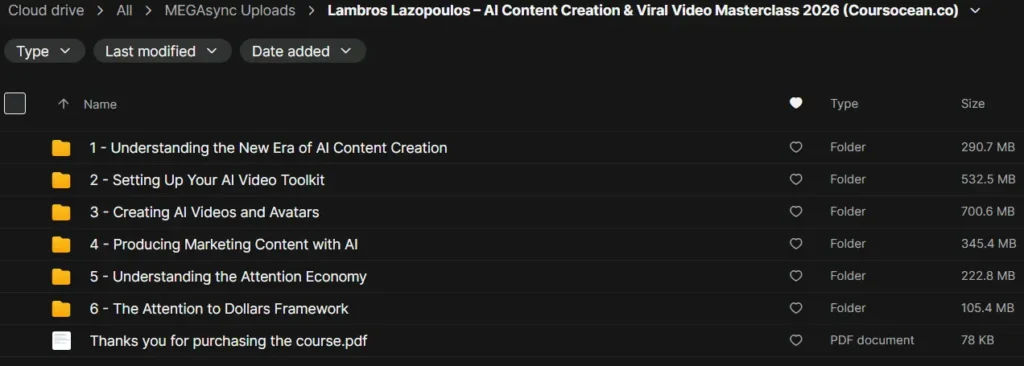
The masterclass is built around a simple production chain: script → voice → visual → automation. Instead of teaching traditional filming or editing, it walks through:
1. Script-first content creation Every video starts as a written script optimized specifically for short-form platforms — YouTube Shorts, TikTok, and Reels have different pacing needs than a long-form YouTube video, and the course treats that as a starting point, not an afterthought.
2. AI voice narration and voice cloning Instead of recording your own voiceover, the course covers generating natural-sounding narration, including cloning your own voice if you want your channel to sound consistently “you” without recording every line yourself.
3. AI avatars as on-screen presenters This is the part that surprises people most — a digital presenter can deliver your script on camera without you ever appearing. It’s the backbone of most “faceless” AI channels today.
4. Turning static images into video Rather than filming B-roll, the course shows how to convert images and simple prompts into video clips, which is often the missing piece for people who have ideas but no footage to match them.
5. Building a repeatable workflow Probably the most underrated section — the course isn’t just “here’s how to make one video,” it’s about building a system you can repeat weekly without starting from zero every time.
Who Should (and Shouldn’t) Take This Course
Based on how the content is structured, it makes the most sense for:
- Beginners who’ve never touched editing software and don’t want to start now
- People who want a faceless channel because being on camera isn’t for them
- Creators or small marketing teams trying to scale output without hiring an editor
- Anyone testing a new content niche before investing in equipment or a full production setup
It’s probably not the right fit if you already have a filming and editing workflow you’re happy with, or if your content style depends heavily on your personal on-camera presence — AI avatars are good, but they’re still not a replacement for genuine personality-driven vlogging.
Is It Actually Worth It?
Here’s the honest, unglamorous answer: AI content tools are evolving fast — faster than almost any other category right now. A course recorded even six months ago can have screenshots and tool walkthroughs that look slightly dated. That’s not a flaw specific to this course; it’s true of every AI-tools course on the market in 2026.
What matters more is whether the framework holds up — the script-to-voice-to-visual-to-automation pipeline — and that structure is genuinely tool-agnostic. Even if a specific AI platform changes its interface next year, the underlying workflow taught here is the same one most successful faceless creators are already using.
My Takeaway
If you’ve been putting off starting a channel because filming and editing feel like too much, this is exactly the kind of system built for you. It won’t magically make a video “go viral” — nothing does that reliably — but it removes the single biggest reason most people quit before they even post their first video.
For anyone serious about growing a faceless YouTube, TikTok, or Reels channel in 2026 without filming or editing experience, it’s a genuinely useful starting point rather than just another AI-hype course.
FAQ
1. Can AI really make a video go viral, or is that just marketing hype?
No tool — AI or otherwise — can guarantee virality. What AI genuinely does is remove production friction (filming, editing, voiceover), so you can post consistently and test more ideas faster. Consistency and volume are still what drive growth; AI just makes it realistic to sustain them.
2. Do I need to show my face or use my own voice to start an AI-based channel?
No. The course specifically teaches faceless content creation using AI avatars as on-screen presenters and AI-generated or cloned voice narration, so you can run a full channel without ever appearing on camera or recording your own voice.
3. Will this course still be useful if the AI tools change or get updated?
Mostly yes. AI platforms update their interfaces often, so specific tool walkthroughs can look slightly dated over time. But the core workflow — script → voice → visual → automation — stays the same regardless of which specific AI tool you’re using, so the framework holds up even as tools evolve.
4. Is this course only for YouTube, or does it work for TikTok and Instagram Reels too?
It’s built for short-form platforms across the board. The scriptwriting section specifically addresses pacing differences between YouTube Shorts, TikTok, and Reels, so the same production workflow can be adapted to all three rather than treating them as separate skill sets.
5. Do I need any prior editing or content creation experience to follow this course?
No — it’s designed for complete beginners. Since the entire workflow replaces traditional filming and editing with AI-generated scripts, voices, and visuals, there’s no prerequisite skill in video editing, on-camera presenting, or production equipment.