


Jesper Nissen – Parasite SEO 2025
$24.99
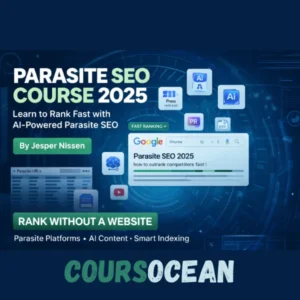
Parasite SEO Course 2025 by Jesper Nissen is a 1.04 GB AI-powered SEO training program covering parasite platform selection .
Discription :-
Building a traditional authority website in 2025 is a long game. Domain authority accumulates slowly, backlink profiles take months or years to develop meaningfully, and the content investment required to compete in most niches with organic search is substantial before the first meaningful traffic arrives. For affiliate marketers, lead generation specialists, and SEO professionals who need rankings faster than that timeline allows, a different approach has been quietly producing results that traditional SEO simply cannot match on speed.
Parasite SEO — the practice of publishing optimized content on high-authority third-party platforms and ranking that content for competitive keywords — has evolved significantly alongside Google’s algorithm updates and the emergence of AI content production tools. In the hands of practitioners who understand the current platform landscape, indexing mechanics, and content amplification strategies, it remains one of the fastest routes to first-page Google rankings available in 2025.
Jesper Nissen’s Parasite SEO Course 2025 is a complete, step-by-step training system built around the modern version of this methodology — combining AI-powered content production with strategic platform selection, social amplification, press release SEO, and advanced indexing workflows into a cohesive ranking system that works without the dependency on an established domain.
Understanding Parasite SEO in 2025: What Changed and What Still Works
The parasite SEO landscape has shifted considerably over the past several years. Platforms that reliably ranked affiliate content in 2020 have tightened their publishing policies. Google’s quality guidelines have become more sophisticated about detecting thin or manipulative content regardless of the domain it lives on. And the practitioners still getting consistent results have adapted their approach accordingly.
What hasn’t changed is the fundamental mechanism. When you publish well-optimized content on a platform that Google already trusts — a domain with established authority, strong crawl frequency, and high topical trust — that content inherits a portion of the platform’s credibility. Under the right conditions, a well-structured parasite page can outrank dedicated websites that have been building authority for years.
The key phrase is “under the right conditions.” Nissen’s course is specifically built around understanding and creating those conditions — choosing the right platforms for specific niches, producing content that meets current quality standards, and deploying the amplification and indexing strategies that accelerate ranking timelines from weeks to days.
Course Structure: Module-by-Module Breakdown
What to Promote and Platform Selection
The program opens with the foundational strategic question that determines everything else: which offers and which platforms create the conditions for fast, stable rankings. Not all Parasite SEO platforms are equal in authority, niche relevance, or publishing flexibility — and matching the right platform to the right offer type is the analytical starting point for every campaign.
The platform selection curriculum covers how to evaluate domain authority and trust signals, which platforms currently rank consistently for commercial and informational keywords, and which niches each platform serves most effectively. The included Parasite URL Database — an Excel file containing a curated list of proven parasite platforms — gives practitioners a practical starting resource rather than requiring them to research and test from scratch.
The “what to promote” component addresses offer selection from an SEO viability perspective: understanding which affiliate and lead generation offers are realistic targets for parasite campaigns versus those where the competitive landscape makes ranking impractical regardless of platform quality.
Social Media Profile Creation and Amplification Setup
Social media properties serve a dual function in Nissen’s methodology — they function both as additional parasite platforms in their own right and as amplification channels that accelerate the indexing and ranking of primary parasite content. Building these profiles correctly from the beginning, with proper optimization for topical relevance and authority signals, determines how effectively they contribute to the overall campaign ecosystem.
This module covers profile creation across the key social platforms used in the course’s amplification framework, optimization practices for each platform type, and how to structure the social presence to maximize its contribution to the broader ranking strategy.
Tumblr and Parasite Platform Setup
Tumblr retains meaningful domain authority and continues to rank content effectively for specific keyword types when setup and content structure are handled correctly. This module addresses the specific technical and content setup requirements for Tumblr campaigns alongside the broader parasite platform configuration principles that apply across multiple publishing destinations.
The platform setup curriculum covers account creation best practices, profile optimization for topical authority, content formatting requirements for each platform type, and the linking architecture that connects parasite properties for maximum authority flow.
AI Content Production: Text, Image, and Video
The AI content production module is where the course’s modern approach most clearly distinguishes itself from older parasite SEO methodology. The combination of AI writing tools, AI image generation, and AI video production has fundamentally changed the economics and scalability of parasite content campaigns — allowing practitioners to produce platform-appropriate content at a speed and volume that manual content creation can’t approach.
The curriculum covers prompt engineering specifically for parasite SEO content — the ready-to-use AI article prompts and social media content prompts included with the course reflect the prompt structures that produce content meeting both platform quality requirements and Google’s current content standards. The emphasis throughout is on producing content that serves genuine user intent rather than thin placeholder text — which is what separates parasite campaigns that hold rankings from those that rank briefly before getting filtered.
The video and image content components address the increasingly important role of multimedia in Google’s current ranking signals and how AI-generated visual content can be optimized for both platform engagement and search visibility.
YouTube Video Optimization
YouTube represents one of the highest-authority parasite platforms available — Google’s own video platform naturally carries significant trust signals, and YouTube content regularly appears in Google search results for commercial and informational queries. Ranking a YouTube video for a target keyword is often faster than ranking any other content type, making it a core component of the EarningsMAX parasite stack.
This module covers video optimization comprehensively: title and description structure for target keyword integration, thumbnail optimization for click-through rate, tag strategy, chapter markup for featured snippet eligibility, and the amplification signals that accelerate YouTube video ranking in both YouTube’s own search and Google’s video results.
Press Release SEO: PRLog and OpenPR Strategies
Press releases published on established distribution platforms represent an often-overlooked parasite opportunity with strong authority characteristics. PRLog and OpenPR both carry domain authority sufficient to rank content for moderate-competition keywords, and the press release format provides a legitimate, policy-compliant publishing vehicle for a wide range of commercial content.
The press release module covers content structure for SEO-optimized press releases, how to frame commercial content within the press release format in ways that platforms accept, distribution timing strategies, and how to integrate press release parasite pages into the broader campaign stack for compounded authority signals.
Indexing Strategies and Fast Crawl Methods
Publishing optimized content on high-authority platforms is only half the equation — getting that content indexed by Google quickly is what determines how fast rankings materialize. The indexing curriculum addresses both the technical mechanics of how Google discovers and processes new content and the specific strategies that accelerate that process beyond standard crawl schedules.
The module covers multiple indexing approaches — from submission methods to amplification signals that trigger faster crawl — and the practical indexing workflows included as course resources give practitioners a repeatable process for ensuring each parasite page moves through Google’s indexing pipeline efficiently. The bonus advanced indexing videos extend this curriculum with additional methods for challenging indexing situations.
Advanced Parasite Stacking and Scaling
The program’s most sophisticated content addresses parasite stacking — the practice of building interconnected networks of parasite properties that pass authority signals between each other and toward primary target pages, compounding the ranking power of individual properties through strategic internal linking and amplification relationships.
The scaling methodology covers how to systematically expand a successful parasite campaign from a single platform to a diversified portfolio of ranking properties, how to manage multiple campaigns across different niches simultaneously, and the new parasite discovery techniques for identifying emerging high-authority platforms before they become widely used by other practitioners.
Included Resources: The Operational Toolkit
The course’s resource package is worth specific attention because it addresses the implementation gap that affects most SEO courses — the space between understanding a methodology and actually executing it efficiently.
The Parasite SEO SOP provides a documented step-by-step blueprint for running a complete parasite campaign from platform selection through ranking achievement. This transforms the course’s methodology into a repeatable operational process rather than a collection of concepts requiring personal synthesis.
The Parasite URL Database in Excel format gives practitioners an immediately usable platform list rather than requiring independent research and authority verification for each potential platform.
The ready-to-use AI article and social media prompts address the most time-consuming component of scaling parasite campaigns — content production — with tested prompt frameworks that produce platform-appropriate content efficiently.
The practical indexing workflows document the specific indexing process as an executable checklist, ensuring nothing is missed in the indexing amplification sequence for each new parasite page.
Why This Approach Makes Sense for Affiliate Marketers in 2025
The economics of parasite SEO compare favorably to traditional affiliate site building for practitioners focused on speed-to-income rather than long-term asset building. A traditional affiliate site typically requires 6–12 months of consistent content production and link building before generating meaningful organic traffic. A well-executed parasite campaign can rank target keywords within days to weeks.
The trade-off is durability — parasite properties are subject to platform policy changes and don’t represent owned assets in the way a domain does. The course addresses this by teaching diversification across multiple platforms and campaign types rather than dependence on any single parasite property. When rankings are distributed across ten well-optimized parasite pages on different high-authority platforms, the risk profile changes significantly compared to a strategy built around a single parasite asset.
Who Gets the Most From This Program
Affiliate marketers who need rankings faster than traditional SEO allows — particularly for time-sensitive offers, seasonal campaigns, or high-competition niches where domain authority is difficult to build quickly — will find the parasite methodology directly applicable to their existing business model.
SEO professionals looking to expand their service offerings or internal capabilities with a fast-ranking complement to traditional SEO work will find the course’s systematic approach and included operational resources immediately deployable. Digital marketers already familiar with basic SEO concepts who want to add parasite strategies to their toolkit will find the technical and content components accessible without requiring deep prior SEO expertise.
Complete beginners to SEO should note that the course assumes some familiarity with basic search optimization concepts — understanding what keywords, backlinks, and domain authority mean will help absorb the more technical indexing and stacking content effectively.
Frequently Asked Questions
Is Parasite SEO still effective after recent Google algorithm updates? The methodology has evolved alongside Google’s updates — the 2025 course specifically addresses current platform selection and content quality standards that reflect the post-helpful-content-update landscape. Platform selection and content quality are more important than they were in earlier iterations of the strategy, which is why the course emphasizes both rather than relying on platform authority alone.
Does this require technical SEO knowledge to implement? Basic familiarity with SEO concepts is helpful but deep technical knowledge isn’t required. The step-by-step SOP and included workflows are designed for practical implementation without requiring specialist technical expertise.
How quickly can parasite pages realistically rank? Ranking timelines depend on keyword competition, platform selection, content quality, and indexing execution. Well-optimized parasite pages on high-authority platforms targeting moderate-competition keywords can rank within days to two weeks under favorable conditions. Highly competitive keywords require more sophisticated stacking strategies and longer timelines.
Is the content produced with AI detectable or problematic for platforms? The AI content curriculum specifically addresses producing content that meets platform quality requirements and serves genuine user intent — not thin, obviously generated text. The prompt frameworks are designed to produce substantive content that passes platform review processes.
What niches work best for Parasite SEO? The methodology works across a wide range of affiliate and lead generation niches. The platform selection module covers niche-to-platform matching specifically, as different platforms have stronger authority signals in different topic areas.
Final Assessment
Jesper Nissen’s Parasite SEO Course 2025 delivers a genuinely current, systematically structured approach to one of the most practically effective fast-ranking methodologies available to affiliate marketers and SEO professionals. The integration of AI content production with strategic platform selection, social amplification, press release distribution, and advanced indexing workflows represents a more sophisticated and complete system than most parasite SEO training currently available.
The included operational resources — SOP, platform database, prompt libraries, and indexing workflows — address the implementation gap that limits the practical value of many SEO courses, giving practitioners the tools to execute the methodology efficiently from day one rather than translating concepts into processes independently.
For marketers who need competitive keyword rankings on timelines that traditional SEO cannot deliver, and who are prepared to invest in learning and executing a systematic approach rather than applying parasite tactics haphazardly, this program provides a thorough and practically grounded foundation for building a fast-ranking affiliate and lead generation operation in 2025.
View More Courses – Click Here
You must be logged in to post a review.
Related products
-

-

-
 Artificial intelligence
AI Powered Digital Marketing Mastery for Online Business Growth
$249.00 Add to cart -

Reviews
There are no reviews yet.