

Futex Live – Market Profile Training
$24.99
OFFICIAL PRICE – $ 199
WE WILL OFFER – $ 24.99
About Course :-
If you have spent any real time studying futures markets, you have probably come across the name FutexLive. For more than a decade, FutexLive has been one of the most trusted names in Market Profile and Volume Profile education, helping traders move away from guesswork and toward a structured, professional way of reading price action. This isn’t a course built around flashy indicators or overnight promises — it’s built on a methodology that institutional traders and prop desks have relied on for decades.
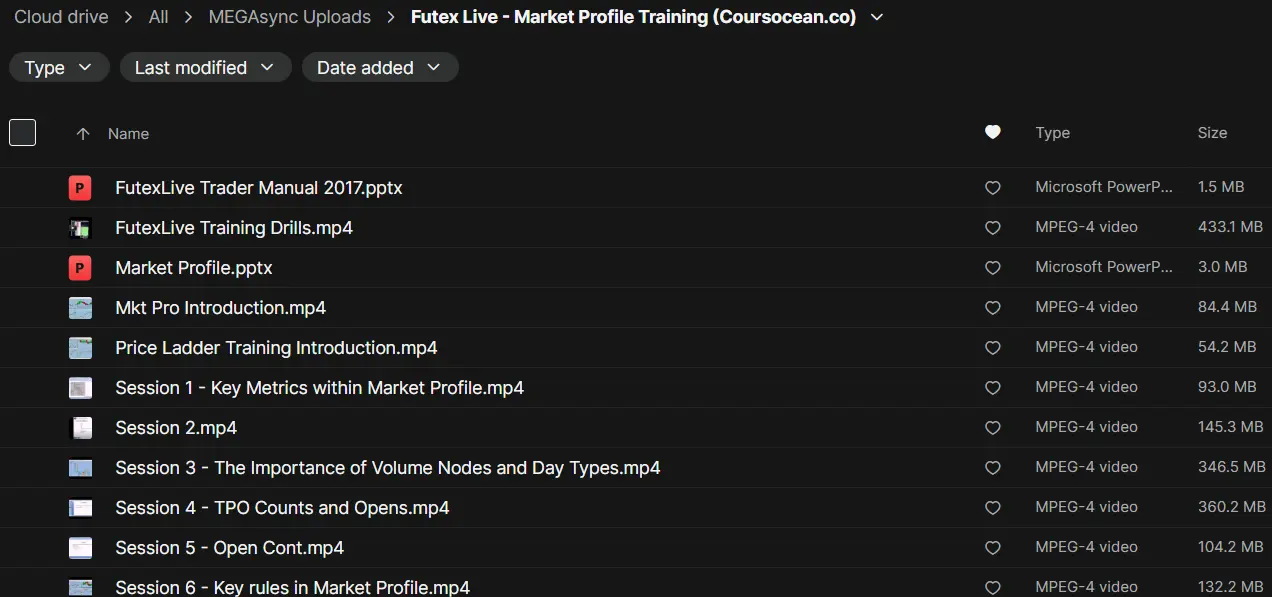
You Can Get 8 Sessions In this Course
By the time you complete the Market Profile Course, you should have a genuine, working understanding of how professional traders actually use this tool to read auction markets, not just a theoretical overview of what the letters and shapes mean.
Learn Market Profile Trading the Way Professionals Actually Teach
FutexLive’s training is delivered through a series of video lessons pulled directly from one of their in-house professional courses — the same material used to train real traders, not a watered-down public version. This makes it one of the more genuine options available for anyone searching for a Professional Market Profile Training program that goes beyond surface-level theory.
The course is structured to take you from the ground up:
- Market Profile for Beginners — starting with the core building blocks: what a TPO chart is, how profiles are built candle by candle (or rather, TPO by TPO), and why price spends more time in some areas than others.
- Profile to Open and Day Types — one of the most important and often misunderstood parts of Auction Market Theory. Understanding how a session opens relative to the previous day’s value, and how that sets the tone for the entire session, is central to reading a Market Profile Day Trading setup correctly.
- Reading the Profile as the Day Develops — this is where most self-taught traders get stuck. FutexLive walks you through how to interpret the profile in real time, adjusting your read as new information enters the market rather than just analyzing profiles after the fact.
This progression mirrors the same logic used in most Advanced Market Profile Course structures, where beginners build a foundation before moving into live interpretation and decision-making.
Auction Market Theory: The Foundation Behind the Charts
At its core, this is an Auction Market Theory Course — Market Profile is simply the visual language used to express auction theory concepts like value, balance, and imbalance. You’ll learn to identify:
- Value Area Trading Strategy — understanding where the market accepted price for roughly 70% of the session’s volume, and why that range matters for both entries and exits.
- Point of Control Trading — learning to spot the price level where the most trading activity occurred, and how it acts as a magnet or a pivot for future price movement.
- TPO Chart Trading — reading the actual letter-based profile structure to understand single prints, poor highs and lows, and excess.
These aren’t abstract concepts in this course — they’re taught as practical, repeatable Market Profile Trading Techniques you can apply to your own charts session after session.
Combining Order Flow With Market Profile
No modern Market Profile education is complete without addressing how order flow fits into the picture. FutexLive’s approach blends Order Flow and Market Profile concepts so you’re not just looking at where price has been, but understanding the aggression and participation behind those moves. This combination is what separates a purely structural read of the market from a genuinely professional one — and it’s a key part of what makes this a true Futures Market Profile Strategy rather than just a charting exercise.
Step-by-Step Sierra Chart Setup Guide
One thing that trips up a lot of traders isn’t the theory — it’s the setup. FutexLive includes a detailed Market Profile Setup Guide specifically for Sierra Chart users, walking through exactly how to configure your charts for a clean, accurate profile read. If you’ve ever searched for a proper Sierra Chart Market Profile Tutorial and come up short, this section alone is worth going through carefully. You’ll learn how to:
- Configure your TPO and Volume Profile chart settings correctly
- Set session times so your profiles build accurately
- Adjust visual settings so value areas, POC, and single prints are easy to spot at a glance
This makes the course genuinely useful for anyone working specifically with Market Profile with Sierra Charts, rather than a generic overview that leaves you to figure out the platform-specific details on your own.
Who Is Behind This Methodology?
Much of the framework taught in courses like this traces back to the foundational work associated with Daniel Goldberg Market Profile teachings and the broader lineage of Auction Market Theory that originated on the trading floors of the CBOT. FutexLive has built on this foundation, adapting it for modern electronic and futures markets while keeping the core principles intact.
Is There a Downloadable Version?
A common question from traders is whether there’s a Market Profile Course Download option or a Volume Profile Trading Course PDF available for offline study. Video-based, in-house course material like this is generally accessed directly through the platform rather than as downloadable files, since the lessons are designed to be revisited and updated over time — but it’s worth checking directly with FutexLive for the most current access options, as offerings can change.
Final Thoughts
Whether you’re just starting out and looking for a genuine Learn Market Profile Trading resource, or you’re an experienced trader looking to sharpen your read of value areas, point of control, and day types, this course offers a structured path grounded in real professional practice. It’s not about memorizing shapes on a chart — it’s about understanding the auction process well enough to anticipate, rather than react to, where the market is likely to go next.
If you’re serious about trading futures using a structural, auction-based approach, taking the time to properly learn Market Profile — and pairing it with a solid understanding of order flow — remains one of the more durable skills you can build as a trader.
Frequently Asked Questions
Is Market Profile the same thing as Volume Profile?
No, and this is one of the most common mix-ups among newer traders. Market Profile organizes activity by time — it tracks how long price stayed at each level throughout the session. Volume Profile organizes activity by volume — it tracks how much was actually traded at each level. They often look similar on a chart and both highlight value areas and points of control, but the underlying question each one answers is different. Most experienced traders end up using both together rather than picking one over the other.
What exactly is the “Initial Balance,” and why does everyone talk about the first hour of trading?
The Initial Balance is simply the range formed during the first two 30-minute periods of a session — typically the first hour. It matters because larger, higher-timeframe participants tend to place a significant share of their orders early, before smaller intraday traders react. That first-hour range effectively becomes a reference point for the rest of the session: whether the market respects it, breaks one side of it, or blows through it entirely tells you a lot about who is in control and what kind of day you might be dealing with.
How many “day types” are there in Market Profile, and do I really need to memorize all of them?
Most Market Profile frameworks describe somewhere between five and seven recurring day types — Normal Day, Normal Variation Day, Trend Day, Double Distribution Trend Day, Neutral Day, and Non-Trend Day being the most commonly referenced. You don’t need to memorize them like flashcards; what actually matters is training your eye to recognize, in real time, whether the Initial Balance is holding or being broken, and whether one side of the market is clearly in control or the day is rotating back and forth. Once you can answer that, the “type” tends to reveal itself naturally as the session develops.
What’s the difference between a Trend Day and a Neutral Day, in plain terms?
On a Trend Day, one side — buyers or sellers — takes control early and rarely lets go, so the range extends steadily in one direction with relatively few pullbacks. On a Neutral Day, both buyers and sellers show up and push the market in both directions, often breaking both the high and low of the Initial Balance, with the session usually settling back somewhere near the middle of the range by the close. Recognizing which one you’re in early enough changes how you should be trading that session.
What does the “80% Rule” mean in Market Profile trading?
It’s a widely referenced guideline rather than a guaranteed outcome: if the market opens outside the previous day’s value area, moves back inside it, and stays there for a meaningful amount of time (often cited as around an hour), there’s a historical tendency for price to continue traveling through to the opposite side of that value area. Traders generally treat this as one input among several, confirming it with how price is actually behaving rather than relying on it in isolation.
Will Market Profile tell me exactly when to buy or sell?
No, and it isn’t designed to. Market Profile is a context and interpretation tool, not a signal generator. It helps you understand whether the market is balanced, trending, or in the process of discovering new value, which then informs the trade ideas you build using your own strategy — whether that’s breakout trading, mean reversion, or trend following.
Do I need Sierra Chart specifically to use Market Profile, or does the theory apply to any platform?
The underlying theory — TPOs, value areas, point of control, day types — applies regardless of platform. Sierra Chart is simply one of the more popular platforms among futures traders for building accurate profiles, which is why a dedicated setup walkthrough for it is so useful. The same concepts can be applied on other charting platforms that support Market Profile or TPO studies.
View More Courses – Click Here
You must be logged in to post a review.
Related products
-
Sale!
 Forex & Currency Trading
FX Goat 3.0 (Updated)
Original price was: $400.00.$10.48Current price is: $10.48. Add to cart -

-
Sale!
 Forex & Currency Trading
Mission FX Full Program
Original price was: $997.00.$15.00Current price is: $15.00. Add to cart -
Sale!
 Cryptocurrency
Main Online Course by MadCharts Academy
Original price was: $650.00.$39.99Current price is: $39.99. Add to cart

Reviews
There are no reviews yet.