

DanDowdTrading
Original price was: $349.00.$24.99Current price is: $24.99.
Learn proven PD Arrays, order flow alignment, and trade model refinement with Dan Dowd’s step-by-step video course. Perfect for traders seeking consistent .
About US :-
Most traders who struggle with consistency aren’t missing more indicators or more setups — they’re missing a clear framework for reading what the market is actually doing before they place a trade. Dan Dowd’s course is built around fixing that. It covers PD Arrays, order flow alignment, inversion setups, and trade model refinement in a structured sequence that builds genuine understanding rather than just adding more concepts to an already crowded toolkit.
The course runs across 7 core lessons plus a bonus module — enough depth to be genuinely useful, focused enough to stay practical throughout.
What You’ll Learn
Starting with PD Arrays, the course builds a clear foundation for identifying where price is likely to react and why. From there it moves into order flow alignment — understanding how to read whether the market’s larger directional bias supports the trade you’re considering, which is one of the more reliable filters for separating good setups from ones that only look good on the surface.
The inversion setup section covers one of the more nuanced concepts in this style of trading — how levels that previously acted as support or resistance can flip and serve the opposite function, and how to use that shift as a trade opportunity rather than being caught off guard by it.
The final section on trade model refinement is where the course gets personal. Rather than just teaching a fixed system, Dan walks through how to take what you’ve learned and shape it into a model that fits your own trading style, risk tolerance, and schedule.
Who This Is For
This course works best for traders who already have some basic market knowledge and are looking to build a more structured, repeatable approach. If you’ve been trading for a while but feel like your results are inconsistent — good stretches followed by drawdowns that give it back — the framework here addresses that pattern directly.
It’s not an entry-level course, but it’s also not overly complex. The concepts are explained clearly enough that a motivated trader with modest prior experience can follow and apply them.
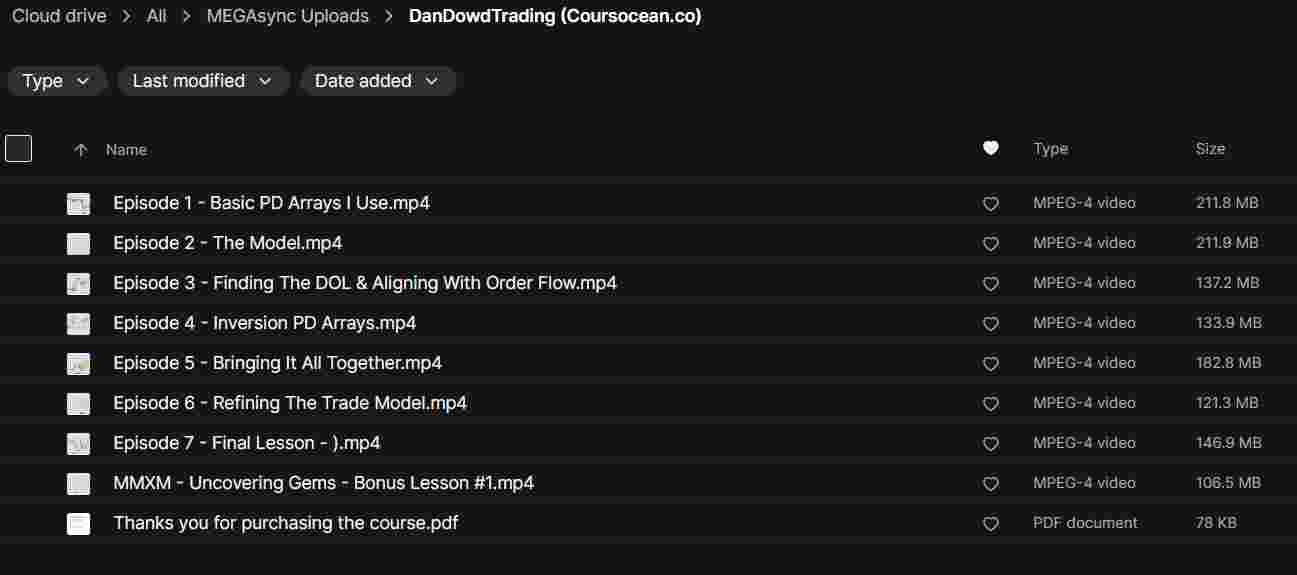
What’s Inside:
-
Episode 1: Basic PD Arrays I Use
-
Episode 2: The Model
-
Episode 3: Finding the DOL & Aligning with Order Flow
-
Episode 4: Inversion PD Arrays
-
Episode 5: Bringing It All Together
-
Episode 6: Refining The Trade Model
-
Episode 7: Final Lesson
-
Bonus: MMXM – Uncovering Gems
Format: Video lessons (MP4) + PDF
Frequently Asked Questions
Q1. What is the difference between ICT concepts and standard retail trading strategies — and why does it matter?
Most retail trading strategies are built around indicators like RSI, MACD, and moving averages — tools that are derived from price itself and therefore always lag behind what the market is actually doing. ICT concepts operate on a fundamentally different premise: that price in every major market is algorithmically driven, and that understanding how those algorithms seek liquidity, fill imbalances, and engineer false moves gives you a framework for reading the market rather than reacting to it. Dan Dowd spent a year immersed in ICT methodology before teaching it, and his course reflects that — it’s not a surface-level overview of terminology, but a practical working knowledge of how manipulation patterns form, why they form at specific price levels, and how to position yourself around them rather than against them.
Q2. Is Dan Dowd Trading suitable for someone who has already tried other trading methods without success?
This is actually the profile the course is most relevant for. Traders who have already spent time with conventional technical analysis — support and resistance, chart patterns, indicator-based strategies — and found it inconsistent tend to get the most from ICT concepts because they already understand what those approaches miss. Dan Dowd’s own trading journey followed exactly this path: years of retail strategies without the precision he was looking for, followed by a complete shift in perspective after applying ICT methodology. The course is taught from that experience, which means it directly addresses the specific gaps that traders coming from a retail background need to fill — rather than starting from scratch with complete beginners in mind.
Q3. How long does it realistically take to understand and apply ICT concepts profitably?
This is one of the most honest questions a prospective student can ask, and the answer requires some candour. ICT methodology has a steeper learning curve than most trading courses because it requires genuinely rethinking how you interpret price — not just adding new tools to an existing approach. Most traders who go through Dan Dowd’s material report that the conceptual shift takes several weeks to internalise, and consistent application in real market conditions takes several months of deliberate practice. The course is structured to accelerate that process — covering market structure, liquidity, order blocks, and fair value gaps in a sequenced way that builds understanding progressively. But applying it profitably is a function of screen time and repetition, not just course completion.
Q4. Which markets and timeframes does the Dan Dowd Trading course focus on?
The methodology taught in Dan Dowd Trading is primarily applied to forex markets — which is where ICT concepts have the most documented application history. The framework covers multiple timeframe analysis: starting from higher timeframes like the weekly and daily to establish directional bias, then moving to the four-hour and one-hour charts to identify key structural levels, and finally using lower timeframes for precise entry execution. This top-down approach is one of the defining features of the ICT methodology and is covered in depth throughout the course. The concepts also translate to indices and gold, which are liquid enough for the liquidity-based analysis the framework depends on to produce reliable readings.
View More Courses – Click here
Only logged in customers who have purchased this product may leave a review.
Related products
-
Sale!
 Trading & Investing
SMB Capital — The Winning Trader
Original price was: $6,000.00.$19.99Current price is: $19.99. Add to cart -
Sale!Forex & Currency Trading
Mahad FX Course (Updated)
Original price was: $700.00.$19.99Current price is: $19.99. Add to cart -
Sale!Trading & Investing
The TFDW Bundle — Trading Fanatic
Original price was: $500.00.$24.99Current price is: $24.99. Add to cart -
Sale!Trading & Investing
Phantom Trading Course 2.0
Original price was: $250.00.$9.99Current price is: $9.99. Add to cart



Reviews
There are no reviews yet.